
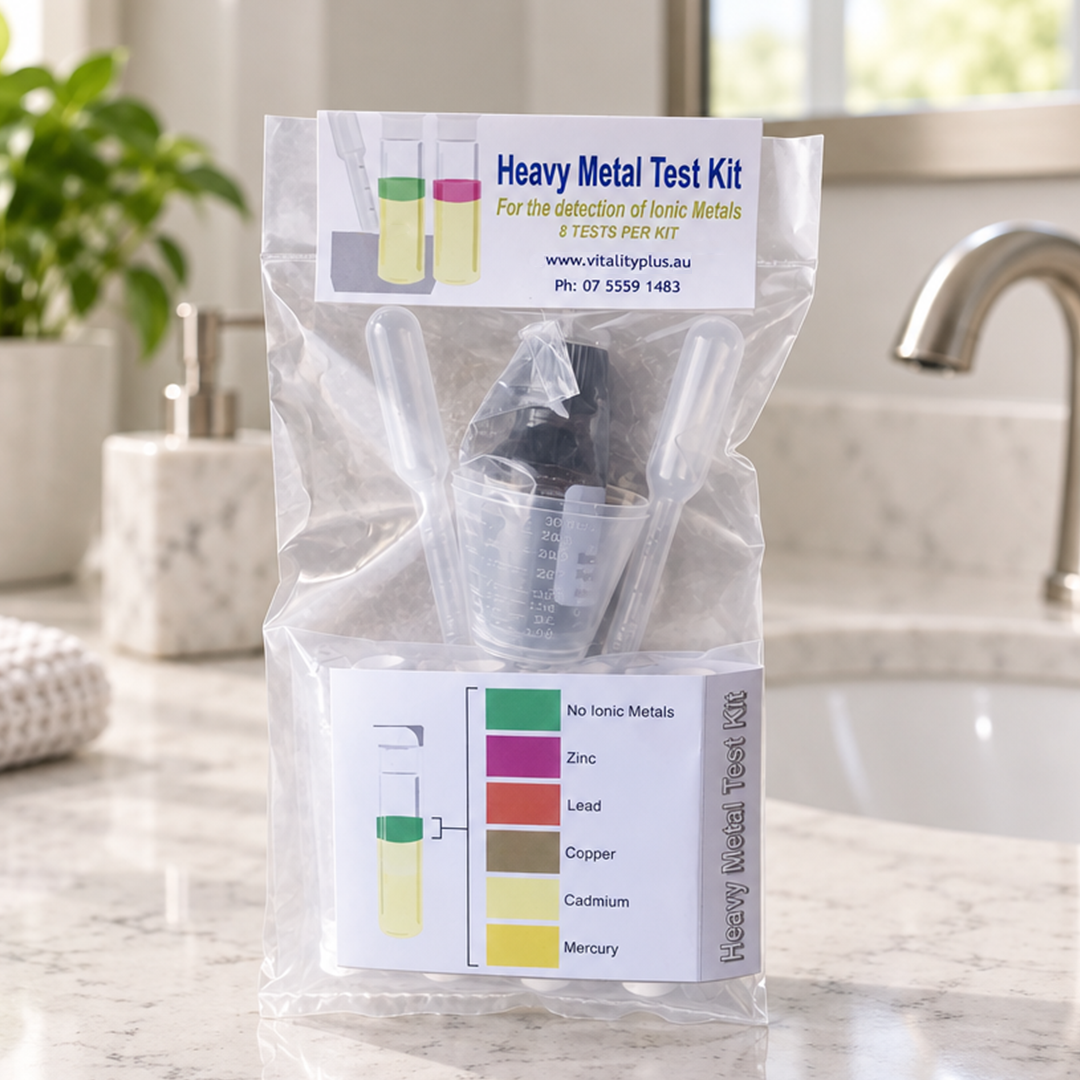


Heavy Metal Test Kit – At‑Home Ionic Metal Screening
The Heavy Metal Test Kit is a simple screening tool designed to indicate the presence of ionic heavy metals in a liquid sample via an easy‑to‑read colour change.
It is suitable for people who want an at‑home option to check samples and observe changes over time.
What the Heavy Metal Test Kit Does
This kit is designed to:
- Indicate the presence of ionic heavy metals in a sample via colour change
- Provide a clear visual result using the supplied colour chart
- Allow repeat testing so you can monitor how your sample results change over time
It is a screening aid only and does not replace professional laboratory analysis or medical advice.
What’s Included in the Heavy Metal Test Kit
Each personal Heavy Metal Test Kit contains:
- 8 individually reagent‑coated test tubes
- 2 pipettes
- 4 sample cups
- 5 mL solvent
- Instruction card
These components are packaged for personal use to make at‑home testing straightforward.
How to Use the Heavy Metal Test Kit
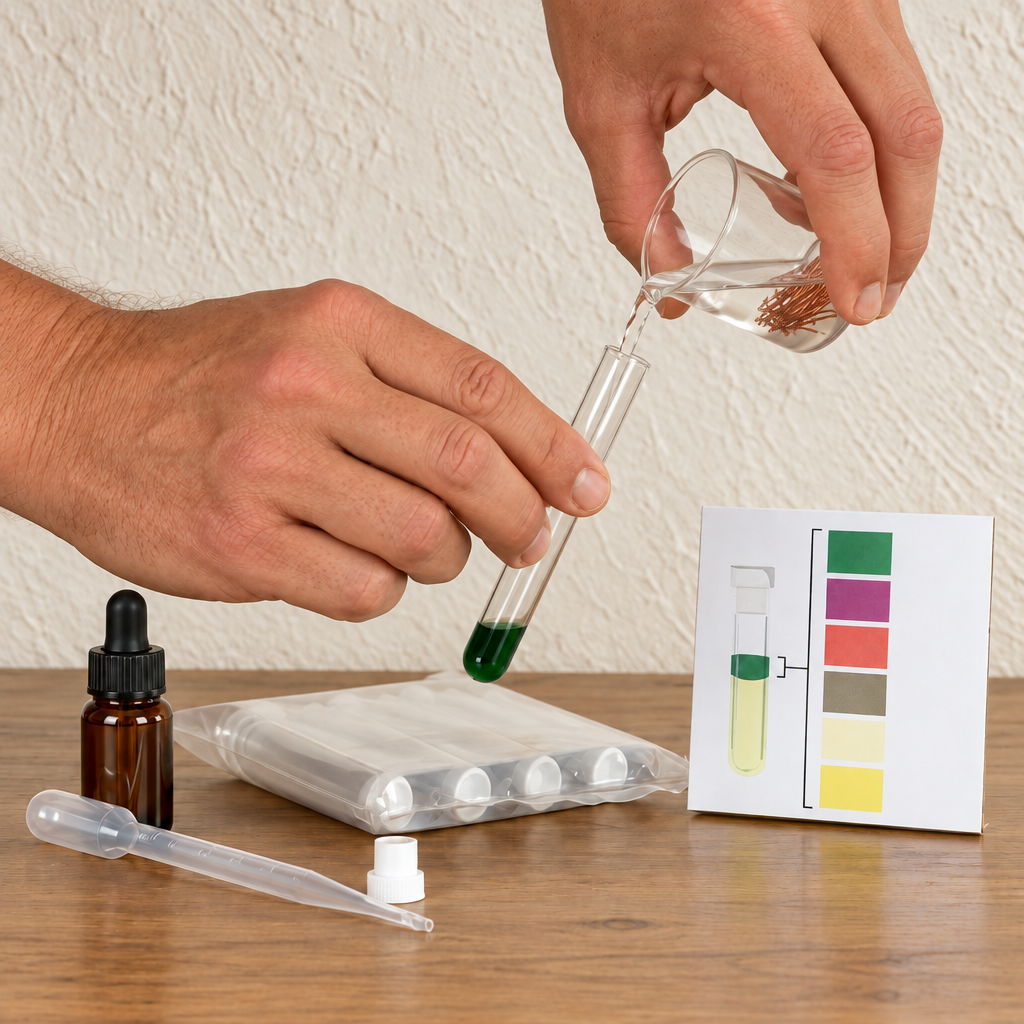
- Collect the sample in one of the supplied sample cups.
- Add the sample and solvent to a reagent‑coated test tube as directed on the instruction card.
- Shake the test tube vigorously for around five seconds.
- Place the tube upside‑down, using the cap as a base, and allow the solution to separate.
- Read the top layer and compare its colour with the supplied chart to interpret your result.
Always follow the instructions included with the kit carefully.
Suitable Sample Types
The Heavy Metal Test Kit can be used with several liquid sample types, such as:
- Urine
- Saliva
- Perspiration
- Tap water
- Bore water
- Tank water etc.
- Paint
- Foods
- Makeup
- Skin care etc.
Since all Heavy Metal ions are water soluble, solids like food items, porcelain dishes, dust samples from carpets, wall paints and wall paper etc. can also be tested for Heavy Metals after soaking them in distilled water.
Use the same basic procedure for each sample type, following the instructions supplied with the kit.
Monitor Your Results Over Time
Because the test is quick to perform:
- You can repeat the test at intervals to see whether the colour result changes
- You can record the colour results and dates to track changes over time
- You can continue testing until your sample consistently shows the “clear” colour on the chart supplied with the kit
This makes the kit useful for ongoing monitoring rather than a one‑off check.
Personal Use and Practitioner Use
The Heavy Metal Test Kit is available in a personal format for home use.
A larger practitioner kit with increased quantities of tubes, pipettes, cups and solvent is available for clinics and practitioners who wish to test multiple clients.
What is a heavy metal?
The term heavy metal refers to any metallic chemical element that has a relatively high density and is toxic or poisonous at low concentrations.
These metals cannot be held in colloidal suspension (like trace metals found in colloidal mineral formulations) and cannot be degraded or destroyed.
Examples of heavy metals include but are not limited to (with the most common metals found in today’s living environment being) Mercury (Hg), Lead (Pb), Cadmium (Cd), Chromium (Cr) and Thallium (Tl).
Thankfully there are ways to detect most toxic metals and most importantly remove these hindrances to good health both quickly and economically.
Ionic Metals Detected Exposed By Colour
What form of heavy metals are present can be detected by a simple colourmetric system.
Using a chemical called ‘dithazone’ these heavy metals are ‘painted’ with a colour as they bind to the dithazone making the presence of the heavy metal visible.
The dithazone reacts differently to each metal, so for Mercury you will always get a yellow colour and for Copper a brown colour.
The difference between the Heavy Metal Test Kit and other methods for detecting heavy metals (Atomic Absorption Spectro Photometry etc.) is that this kit will exclusively detect ionic and free radical generating heavy metals.
This means that a needed element such as Zinc will not be detected with the test kits but ionic Zinc that produces free radicals will be.
We know that a change in colour of the green test solution indicates the presence of ionic metals.
Any product that is able to ‘chelate’ (neutralise) ionic metals must be able to maintain a green colour once the chelate is added to the sample containing the contaminate.
Who Developed the Science?
In 1925 Helmut Fischer of the Siemens Concern in Berlin succeeded in detecting heavy metal ions by means of a dithizone process.
As a reagent, dithizone is able to indicate the presence of heavy metal ions in qualitative and quantitative terms. Dithizone, in binding the metals (binds to Cu, Zn, Cd, Hg, Pb, Mn, Co, Ni,), form coloured complexes in the interior of the molecule which are soluble in non-polar organic solvents.
The coloration of these solutions is very intense, its particular coloration determined by the atomic radius of the respective metal present in the complex.
The reaction times of the heavy metal ions vary; therefore, depending on their respective concentrations, different colorations may occur from which one can, in addition to the qualitative conclusions also semi quantitative ones regarding the contaminant. (At the lower ppm level, even at the ppb level).
The solvent used Diphenylthiocarbazone (Dithizone) is especially developed to bind the dithizone molecules quickly and effectively to ensure dissolution for testing.
Testing Protocol
- Take a fresh coated test tube, remove the cap, and using a dedicated pipette, add approximately 0.5 ml (~ 12 drops) of Solvent to the test tube.
- Replace the cap and shake the test tube vigorously for about 30 seconds to effect dissolution of Dithizone in the solvent. Invert the test tube and let it stand using the cap as the base for another 30 seconds. The solution should now be green and fresh and ready for use.
- Remove the test tube cap, pick up approximately 2-3mL of testing sample from the sample cup using a clean pipette and add it to the test tube. Replace the test tube cap.
- Shake vigorously for about 5 seconds, then place the test tube into one of the support holes in the stand provided and allow for the solution to separate.
- Read the top layer and compare it with the chart provided. If colour stays green, no ionic metals have been detected.

The following are general notes that may assist in the reading:
- You may not find exactly the same colours as the chart in every day reality. This is due to the complexity of testing mediums and the reaction to dithizone.
- Sometimes, not only the ‘ring’ on top of the liquid changes colour, but also the entire solution below the ring may change colour as well.
How to use your heavy metal test kit
Frequently Asked Questions
Q: What is the Heavy Metal Test Kit used for?
A: It is used as an at‑home screening tool to indicate the presence of ionic heavy metals in a liquid sample through a simple colour‑change reaction. It is not a diagnostic test and does not measure precise concentrations.
Q: Can I use the kit for my urine sample?
A: Yes. The kit is suitable for use with urine and other liquid samples as directed on the instruction card.
Q: How do I read the results?
A: After mixing the sample and solvent in the reagent‑coated tube, allow the solution to separate, then read the colour of the top layer and compare it to the supplied colour chart.
Q: Is this kit a replacement for laboratory testing or medical advice?
A: No. The Heavy Metal Test Kit is a screening tool only. It is not intended to replace professional laboratory analysis or the evaluation, judgment, diagnosis or care of a health care provider.
Important Information & Disclaimer
- Information about this kit is general in nature and is intended for educational and informational purposes only.
- The Heavy Metal Test Kit is a screening tool and does not provide a medical diagnosis.
- This product is not intended to diagnose, treat, cure or prevent any disease or health condition.
- Any medical, nutritional, dietetic, therapeutic or other decisions, dosages, treatments or drug regimes should be made in consultation with a qualified health care practitioner.
- Do not discontinue any prescribed treatment or medication without first consulting your physician, clinician or therapist.
Use this product at your own risk. If you have symptoms, concerns about heavy metal exposure, or questions about your health, seek advice from a suitably qualified health care provider.
Related articles
How to Use your Heavy Metal Test Kit
Where Does the Body Store Heavy Metals?
If You’re Sick, Do This
How to Test Your pH Levels



George –
An easy kit to use
Thank you for all your help these last couple of days. The tests changed colour instantly to what we think is lead. We do live in an older suburb so we checked our water to and same result. My wife will order the filter in the next couple of days. Thank you again.
Joseph T. –
Recommended
We had no idea what to expect but now we have something to the look further into. Highly recommended if things haven’t been well for some time. Quite eye opening actually!
Conway –
Great Little Kit
I tested our local tap water against the filtered drinking water, and there was a total difference with filtered showing No Ionic Metals, but the tap water showed instant Lead contamination. More than anything this showed my water filter is working very well for filtering out Ionic Metals. Now for urine and saliva.
I am so glad I got this little kit.
Luke D’Agostino –
New product for me
Was great